 ArtFarm







Tin tức
HỪNG ĐÔNG TRÊN VỊNH SAN FRANSISCO
Th5
English below
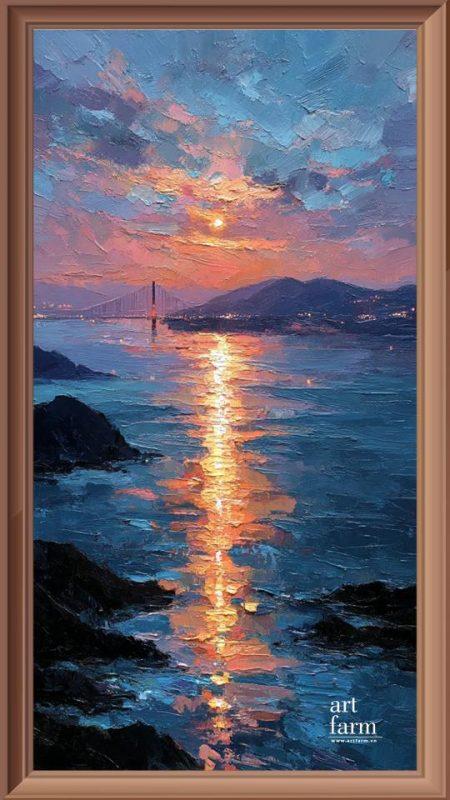
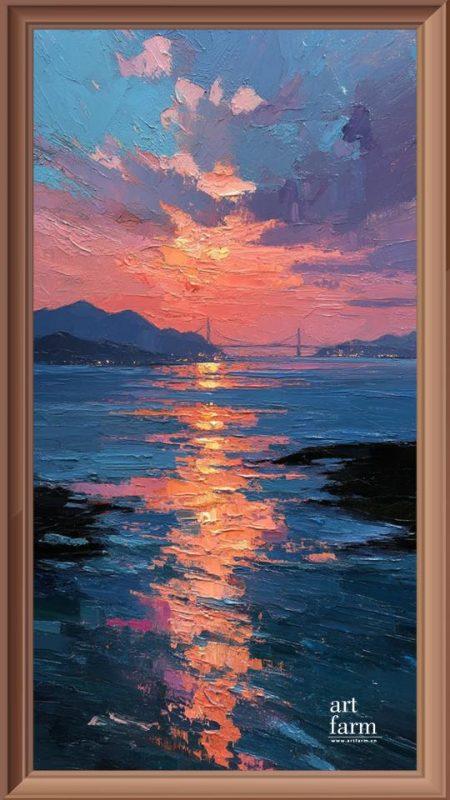
Có những bức tranh phong cảnh không chỉ tái hiện một địa điểm, mà làm hiển lộ một trạng thái tinh thần của ánh sáng. Chùm tranh bình minh trên Vịnh San Francisco nhìn từ Marin Headlands thuộc về loại hình ấy. Ở đây, bình minh không chỉ là thời khắc của thiên nhiên; nó trở thành một chuyển động nội tâm, nơi cây cầu, mặt nước, bầu trời và lớp sơn dày cùng hợp lực để viết nên một bài ca thị giác về thức giấc, hy vọng và vẻ đẹp mong manh của khoảnh khắc đầu ngày.
Điểm nổi bật nhất của loạt tranh là cách ánh sáng được kiến tạo như một dòng chảy trung tâm của cảm xúc. Mặt trời không xuất hiện như một đĩa sáng đơn thuần, mà như một hạt nhân thị giác, từ đó sắc đào, hồng tím, vàng cam và lam lạnh tỏa ra, va đập và phản chiếu lên mặt nước. Chính dải phản quang kéo dọc từ đường chân trời xuống tiền cảnh đã tạo nên nhịp cảm xúc chủ đạo: mắt người xem bị dẫn đi như đang bước vào chính vùng rung động của buổi sớm. Trong một số bức, cầu Cổng Vàng hiện lên rõ hơn như một hình tượng trụ vững giữa chuyển động; ở những bức khác, cây cầu chỉ còn là một ký hiệu mảnh, lùi ra phía sau để nhường chỗ cho mặt nước và bầu trời cất tiếng. Sự thay đổi ấy khiến chùm tranh có tính biến tấu, chứ không rơi vào lặp lại mô-típ.
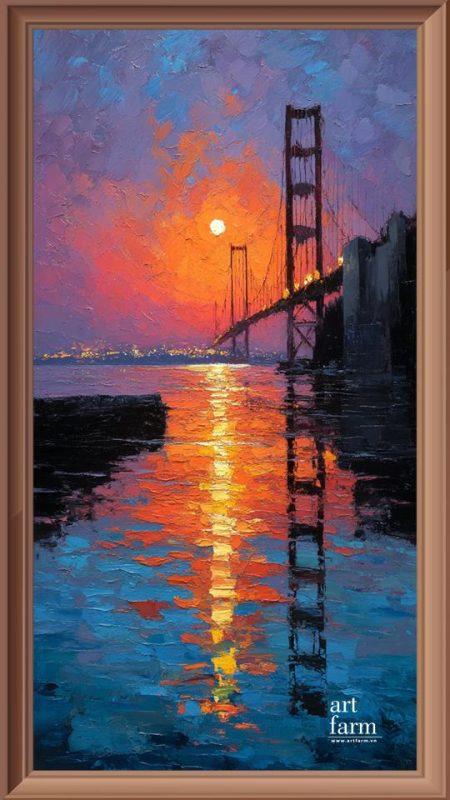
Về bút pháp, đây là một ngôn ngữ impasto được đẩy khá mạnh nhưng vẫn giữ được tiết chế thẩm mỹ. Những vệt bay màu, những mảng sơn dày, những lớp chồng lấn sắc độ làm cho bề mặt tranh trở thành một thực thể vật chất sống động. Người xem không chỉ nhìn thấy bình minh; họ gần như cảm được độ ẩm của không khí, nhịp chuyển của nước và sức căng của ánh sáng đang phá vỡ đêm tối. Điều đáng nói là chất liệu ở đây không chỉ nhằm gây ấn tượng thị giác. Nó còn làm nên chiều sâu biểu cảm: nơi lớp sơn dày là nơi cảm xúc lắng tụ, nơi màu sắc được đẩy tới rìa của ký ức và trực giác.
Ở tầng sâu hơn, chùm tranh này cho thấy một cách nhìn hiện đại về phong cảnh: thiên nhiên không còn là ngoại giới đứng ngoài con người, mà là bề mặt phản chiếu tâm trạng. Bình minh trên vịnh vì thế không chỉ đẹp; nó mang phẩm chất chữa lành. Trong sắc hồng tím và lam thẳm, người xem cảm được một nỗi dịu lại rất khẽ, như thể sau tất cả xao động của đêm, thế giới vẫn đủ bao dung để mở ra thêm một ngày mới.
LOẠT TRANH THUYẾT PHỤC Ở KHẢ NĂNG BIẾN BÌNH MINH THÀNH MỘT TRƯỜNG CẢM XÚC, NƠI ÁNH SÁNG KHÔNG CHỈ SOI TỎ PHONG CẢNH MÀ CÒN ĐÁNH THỨC CHIỀU SÂU NỘI TÂM CỦA NGƯỜI XEM.
Nhìn từ tiếp nhận phê bình hội họa đương đại, chùm tranh này thành công không chỉ vì vẻ đẹp phong cảnh hay sức hút của biểu tượng San Francisco, mà bởi nó chạm tới điểm cốt lõi hơn của hội họa: làm cho người xem cảm được thời gian bằng màu sắc và chất liệu. Chính ở đó, bình minh không còn là một khoảnh khắc trong ngày, mà trở thành một kinh nghiệm thẩm mỹ bền lâu.
—————
DAWN OVER SAN FRANCISCO BAY
Some landscapes do not merely depict a place; they reveal the inner condition of light itself. This series of sunrise paintings over San Francisco Bay, seen from the Marin Headlands, belongs to that order. Dawn here is not simply a natural event. It becomes an inward movement, in which bridge, water, sky, and thickly worked paint join together to compose a visual hymn to awakening, hope, and the fragile beauty of the day’s first hour.
The most striking achievement of the series lies in the way light is constructed as the central current of feeling. The sun is not treated as a mere disc of brightness, but as a visual nucleus from which peach, violet-pink, molten gold, and cool blue radiate outward, collide, and reverberate across the surface of the bay. It is this vertical path of reflected light, stretching from the horizon into the foreground, that establishes the emotional rhythm of the works: the viewer’s eye is drawn inward as though entering the vibration of morning itself. In some paintings, the Golden Gate Bridge appears more distinctly, standing as a resilient form amid change; in others, it retreats into a slender sign, yielding the pictorial voice to sky and water. This variation gives the series the quality of improvisation rather than repetition.

In terms of handling, the impasto language is pushed to a forceful degree while retaining aesthetic control. Palette-knife sweeps, dense paint ridges, and layered color masses transform the painted surface into a living material presence. One does not merely see the sunrise; one almost feels the humidity of the air, the movement of the water, and the tensile pressure of light breaking through the remains of night. What matters is that materiality here does not serve only to impress the eye. It deepens expression: where the paint thickens, emotion seems to gather; where color is pushed to its edge, memory and intuition begin to speak.
At a deeper level, the series proposes a distinctly modern understanding of landscape: nature is no longer an exterior scene separate from human experience, but a reflective surface for mood itself. The sunrise over the bay is therefore not only beautiful; it also carries a restorative quality. Within the violet-pink glow and the cool blue depth, the viewer senses a subtle quieting, as though after all the tremors of night, the world still remains generous enough to open into another day.
THE STRENGTH OF THE SERIES LIES IN ITS ABILITY TO TURN DAWN INTO A FIELD OF FEELING, WHERE LIGHT ILLUMINATES NOT ONLY THE LANDSCAPE, BUT THE VIEWER’S INNER DEPTH.
From the perspective of contemporary art criticism and reception, the series succeeds not only through the allure of landscape or the iconic power of San Francisco, but because it touches something more essential in painting: the capacity to make time itself felt through color and material. At that point, dawn ceases to be merely an hour of the day and becomes an enduring aesthetic experience.